
Ashland County Property Tax Records Search
Ashland County Property Tax Records are easiest to navigate through the county's own treasurer, assessment, and land information pages because those tools let you move from a parcel search to a bill image, payment history, and map context without leaving the county system. If you need a current receipt, a historical bill, an owner lookup, or a quick check on assessment data, the county's hosted search tools are the fastest place to begin. That also makes them useful for escrow checks, parcel verification, and appeal preparation when you want the record itself rather than a secondary summary.
Ashland County Property Tax Records Portal
The county's main search portal is the Ashland County property tax records site, where you can search by parcel number, owner name, address, or tax bill number. The portal is guest-accessible, mobile friendly, and available around the clock, which is useful when you need to check a balance outside office hours or review the history of a parcel before a deadline. It includes current and historical tax information, assessment data, payment history, printable tax bills, and other parcel details that often answer the first question before you ever call the office.
For many users, the value of Ashland County Property Tax Records is that the portal does not stop at the bill amount. It lets you see the context behind the bill, including how the account has been paid over time and whether the parcel carries information that needs to be matched to an assessor's record. That makes it especially useful for owners, title researchers, and anyone who wants to compare the bill to the assessment roll before asking for help.
The portal also supports a quick reality check on whether a parcel was entered with a bill number, mailing address, or owner variation that differs from what you expected. When a record is old or the ownership chain has changed, that flexibility makes the county search much easier to use than a static PDF list.
Treasurer Services and Tax Receipts
The Ashland County Treasurer is located at 201 W. Main St. Room 201, Ashland, WI 54806, and the office phone number is (715) 682-7012. The courthouse second floor includes the Treasurer, GIS, Land Description and Tax Lister, and Register of Deeds offices, which is convenient when a property tax question turns into a map, ownership, or recording question. The county also notes that users can self-print tax receipts and check escrow status through the tax system, which is helpful if a lender or title company needs confirmation before a closing.
The county treasurer page is also where you can confirm practical limits and delinquency details. Ashland County allows a maximum of 10 parcels per online transaction, which matters if you are paying for a larger portfolio or a family group of parcels. The county also publishes tax deed notices for delinquent properties, so the record can show more than just whether a bill was paid. It can also show when a parcel has moved into a collection stage that deserves closer attention. The treasurer office screenshot below comes from the county treasurer page.
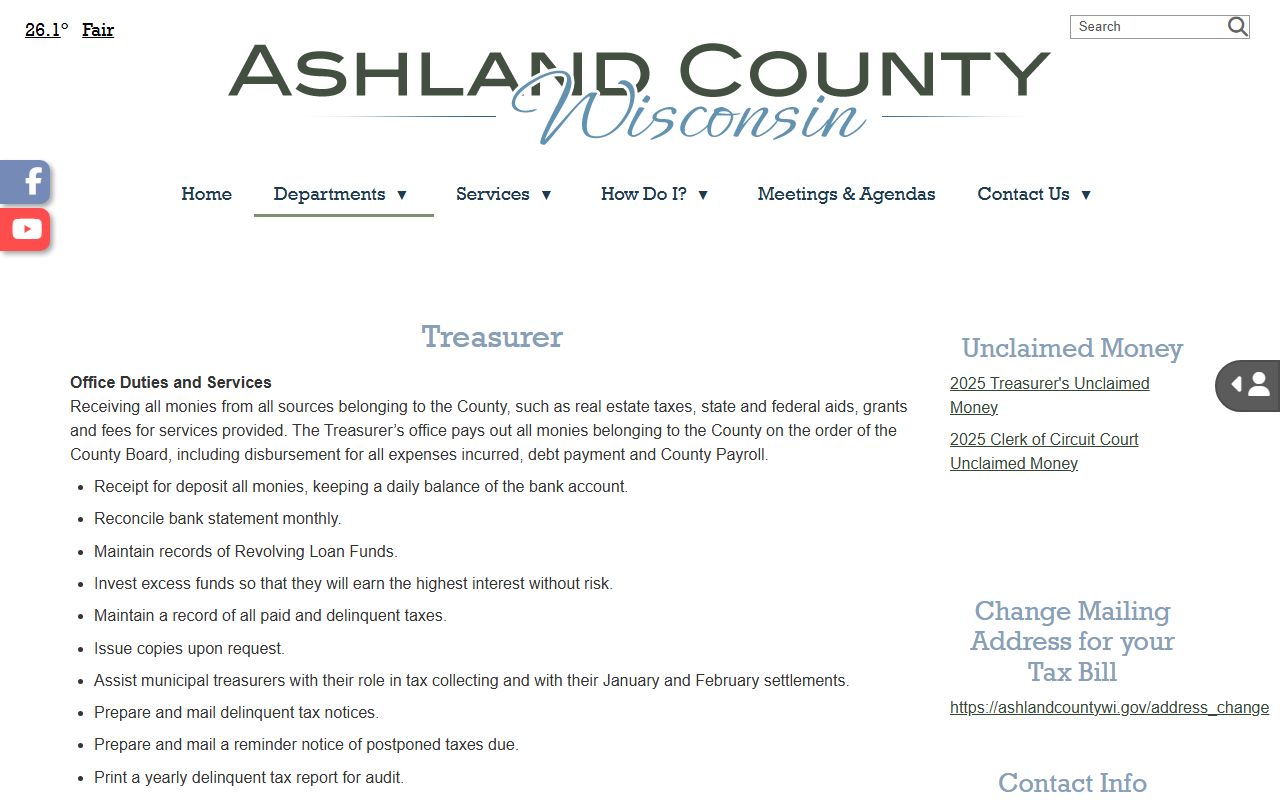
It shows the office entry point that supports receipts, escrow checks, and delinquent-property notices, which makes it a practical companion to the online portal when you are validating Ashland County Property Tax Records in real time.
Finding Ashland County Property Tax Records by Parcel
When you search Ashland County Property Tax Records by parcel number, owner name, address, or tax bill number, you can usually narrow the file down quickly enough to confirm whether you have the right property. That matters because the county's assessment information is tied to the parcel, not just the mailing label. The assessment information page points users to the Real Property Lister at (715) 682-7003 and to municipal assessor contacts, which is the right place to go when a parcel characteristic, classification, or roll entry needs clarification.
The assessment page also covers open book schedules, board of review procedures, and the appeal process. In practice, that means a tax record search is only the first step. If the value seems wrong, you use the search to gather the parcel history, then use the assessment resources to compare the record to the current roll and ask for a correction or hearing if needed. That is especially important when a parcel has changed use, split, or ownership and the tax record still reflects older characteristics.
For Ashland County Property Tax Records research, the combination of parcel search and assessment contact information creates a cleaner workflow. You can confirm the bill first, then ask the assessor or lister for the characteristics that explain the value. That is usually a better sequence than starting with a phone call and trying to reconstruct the property from memory alone.
Ashland County Property Tax Records Maps and Document Search
The county's land information page at Ashland County land information ties property tax records to GIS mapping, parcel boundaries, ownership records, assessment overlays, zoning, aerial photography, and maps. That is useful when you need to match a bill to a legal parcel or verify whether a property line or overlay condition helps explain what you see in the tax record. When a taxpayer or researcher only has an address, the map layer often confirms which parcel should be searched in the tax system.
Ashland County also maintains a deeper WGXtreme search site with advanced search tools, legal description search, map, buffer, and polygon search, saved searches, owner history, class, assessment year, and land, improvement, total, and fair market value fields. The map side includes layers and base maps, and the output tools support print, export, and share workflows. That is a powerful set of features when you need more than the standard portal gives you, especially for research projects that compare several parcels or trace a property over time. The same system also references recorded documents through Tapestry and Fidlar, which helps connect the tax side of the file to the deed side of the file.
For Ashland County Property Tax Records, that document and map combination is the difference between a simple lookup and a usable property history. It lets you start with the tax bill, move through the map, and end with the recorded document that explains why the account looks the way it does. If you are trying to track a conveyance, a split, or a change in assessment year, that is the chain you want.
Open Book and Board of Review for Property Tax Records
Wisconsin's assessment appeal structure applies in Ashland County just as it does elsewhere in the state, and the county's assessment page points users to the open book and board of review process. The main state references are Wis. Stat. Chapter 70, Wis. Stat. Section 70.47, and the Department of Revenue's materials such as PB-055 and the Wisconsin Property Assessment Manual. Those sources explain the formal steps, the notice requirements, and the evidence rules that govern an assessment challenge.
Open book is the first discussion with the assessor. Board of Review is the formal hearing. State law requires notice before the hearing, and in most cases the property owner must give notice of intent to object at least 48 hours before the first meeting. The Board of Review meets during a 45-day period that begins on the fourth Monday of April, and the hearing record is preserved because later appeals depend on it. If the board does not resolve the issue, the next step may be a circuit court certiorari review or a Department of Revenue appeal under Wis. Stat. Section 70.85 for eligible properties.
For someone reading Ashland County Property Tax Records, the practical value is simple: the bill tells you what was charged, and the appeal record explains whether the value or characteristics were later challenged. If the parcel has a changed assessment, the open book and board of review history may be the only place that change is explained clearly.
Delinquent Taxes and State Guidance
Delinquent parcels in Ashland County can show up in the tax record through tax deed notices, payment histories, escrow checks, and the county's delinquent tax handling notes. The WGXtreme notes also mention payment plans for delinquent taxes, auto-pay reminders, card payment fees of 2.5 percent, and e-check fees of 1.50, all of which are useful when a parcel owner is trying to catch up on a balance. Because the county portal lets you see payment history alongside the bill, you can usually tell whether a parcel is current, late, or already moving through the delinquency process without guessing.
For broader Wisconsin guidance, the Department of Revenue explains the statewide property tax framework, Wis. Stat. Section 73.03 describes DOR supervision of assessment practice, and PB-060 helps property owners read a bill and understand the credits and levies that appear on it. If the parcel is agricultural, PB-061 explains use-value assessment. The annual Town, Village and City Taxes Bulletin is also useful when you want to compare local values and rates across the state.
That mix of county and state sources makes Ashland County Property Tax Records more than a payment lookup. It is the place where the bill, the map, the assessment roll, and the delinquency history meet. Once you have those pieces together, it is much easier to decide whether you need to pay, request a receipt, or start a formal review.