
Columbia County Property Tax Records Guide
Columbia County Property Tax Records are best approached through the county's own property and land systems because they combine tax bills, payment status, assessment detail, parcel characteristics, and office contact information in one place. If you are trying to confirm a bill before a due date, look up a parcel after a split or combination, or get a printable receipt, the county's official tools are built for that workflow. Start with the parcel or street name if you have it, then move into the record that shows the current year, older tax years, and the related property data so you can see how the account is put together.
Columbia County Property Tax Records Portal
The county's main entry point for Columbia County Property Tax Records is the Ascent Land Records portal, which is available 24/7 and works on mobile devices as well as desktop browsers. It supports searches by parcel, last name, and street name, so you can start with whichever clue you have and move toward the correct account. The portal also shows current and historical taxes, assessment data, payment status, printable tax bills, receipts, and property characteristic data, which makes it useful whether you are researching a single year or building a longer record history.
The screenshot below comes from the county's property tax site at Columbia County and shows the office entry point for Columbia County Property Tax Records research.
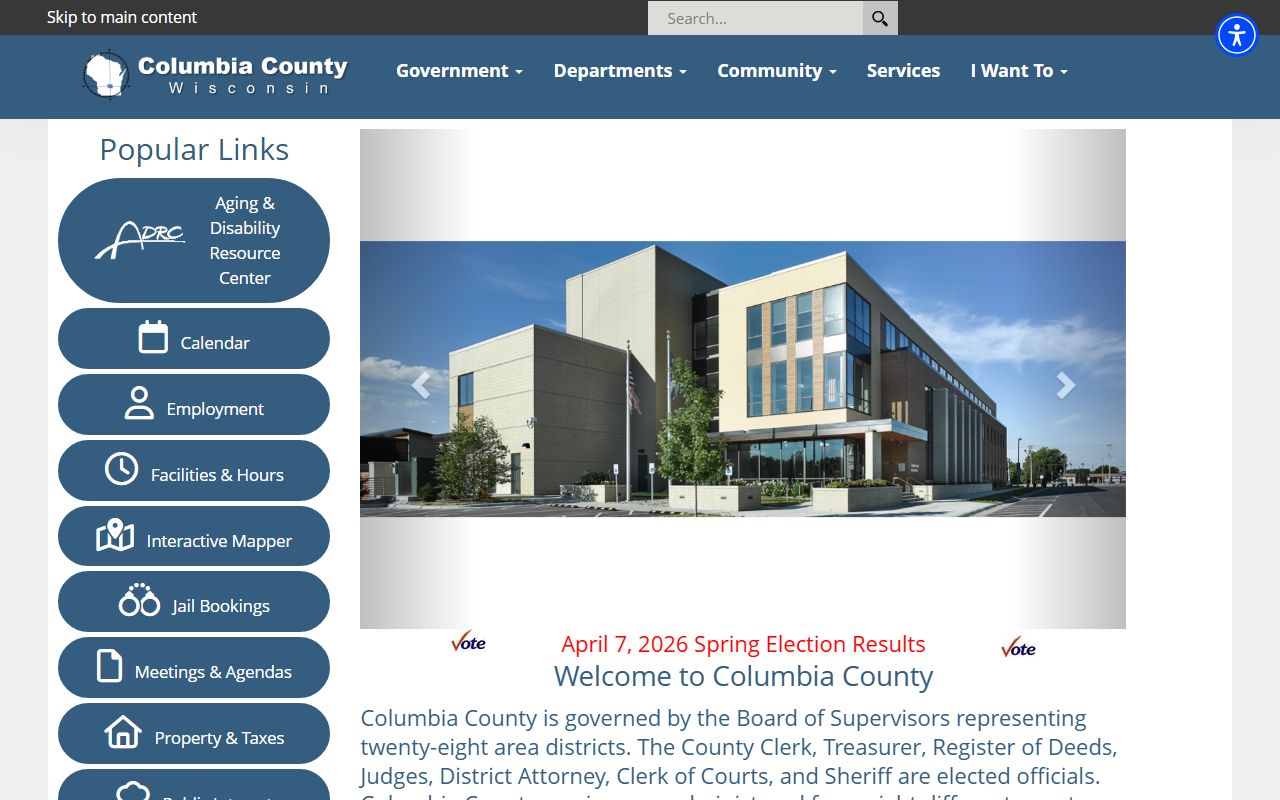
That page is a practical starting point when you want to move from a general county contact page into the actual tax bill, parcel, or receipt record tied to a property. It also helps when you are trying to confirm whether the county has posted the latest bill image, because the online system is designed to surface the tax record itself rather than a summary written by a third party.
Columbia County Treasurer and Payment Timing
Columbia County's payment rules are organized through the treasurer and payment pages at the county payment site, where the office lists the mailing address as PO Box 198, Portage, WI 53901 and provides payment options through Point & Pay. The treasurer can be reached at (608) 742-9613, and the land information department is available at (608) 742-9616 or land.information@co.columbia.wi.us. The county says the first installment is due on January 31 locally and the second installment is due on July 31 at the county level, so the due date depends on which part of the tax cycle you are paying.
The payment page also explains the fees for online payments, including a 2.39 percent card fee and a $1.50 e-check fee for payments under $10,000. If you prefer to pay in person, mail, or the drop box, those routes are still available, and the county notes that interest applies when taxes are late and that unpaid taxes can move into the tax deed process. Columbia County also notes that Associated Bank in Lodi accepts in-person July payments, which is useful if you want a local walk-in option after the first installment window has passed.
For Columbia County Property Tax Records users, that timing matters because the bill record alone does not always tell you whether a payment has already been routed to the municipal treasurer or the county treasurer. The county's payment system and tax bill images together give you the posted status, the installment you are dealing with, and the receipt history in one place.
Searching Columbia County Property Tax Records
The deeper Ascent search screen at Columbia County Property Tax Records search lets you search by parcel, owner name, address, municipality, or tax year, and it adds auto-complete plus GIS map support. That means the search can adapt whether you are working from a tax notice, a street address, or a parcel number copied from another record. It is especially useful when you want to compare land value, improvement value, total value, fair market value, change amount, change percent, class, and exemptions without leaving the county system.
Columbia County also uses the property information side of the system for municipal changes, parcel splits, parcel combinations, and address updates. If a record looks wrong because the parcel was altered, the portal is often the first place where the correction appears. For Columbia County Property Tax Records work, that is important because the assessment, billing, and geographic layers all need to match before a record can be trusted for a closing, a payment check, or a valuation review.
When you are working through a search result, the county's property data can save time by showing the ownership history, mailing address, and parcel characteristics next to the tax record. That makes it easier to tell whether the bill belongs to the right parcel, whether the legal description lines up with the map, and whether a change in the mailing address was already entered through the county portal.
Columbia County Assessment and Value Review
Assessment questions are handled through the county assessor page at Columbia County assessor information, which connects users to municipal assessor contacts, assessment rolls, valuation notices, open book, board of review, appeals, property characteristics, equalized values, and revaluation work. That page is the right place to confirm which assessor handles a municipality and to see the notice or review process that affects a parcel's value. If you are reading Columbia County Property Tax Records and a value looks unusual, the assessment page is often the fastest way to see whether the question is about the bill, the data behind the bill, or the annual valuation process.
Wisconsin's statewide assessment framework explains why that distinction matters. Wis. Stat. Chapter 70 governs taxation and assessment, while Wis. Stat. Section 70.47 sets the Board of Review process. The Department of Revenue's government tax guidance page, the Wisconsin Property Assessment Manual, and PB-055 give the statewide context for open book, evidence, and review procedures. If you need a general owner's guide to assessment basics, PB-060 is a good companion reference.
That set of county and state sources is helpful because Columbia County Property Tax Records are not just a payment record. They are also tied to the assessor's valuation work and to the municipal review calendar. When a property changes class, has a different equalized value, or moves through open book and board review, the tax record may only make sense once you compare it with the assessment notice and the county's review notes.
Columbia County Property Tax Records Maps and Address Changes
The county's land information resources help connect Columbia County Property Tax Records to the parcel on the ground. The land information department can help with address changes, and the county's property data also supports municipal changes, parcel splits, parcel combinations, and related updates that affect the way a bill is displayed. For a county that relies on parcel-level recordkeeping, that connection matters because an address alone is not always enough to identify the right account when roads are renamed, parcels are split, or neighboring properties share similar mailing details.
The screenshot below comes from the county's land records portal at Ascent Land Records, which is the county source for Columbia County Property Tax Records mapping and parcel detail.
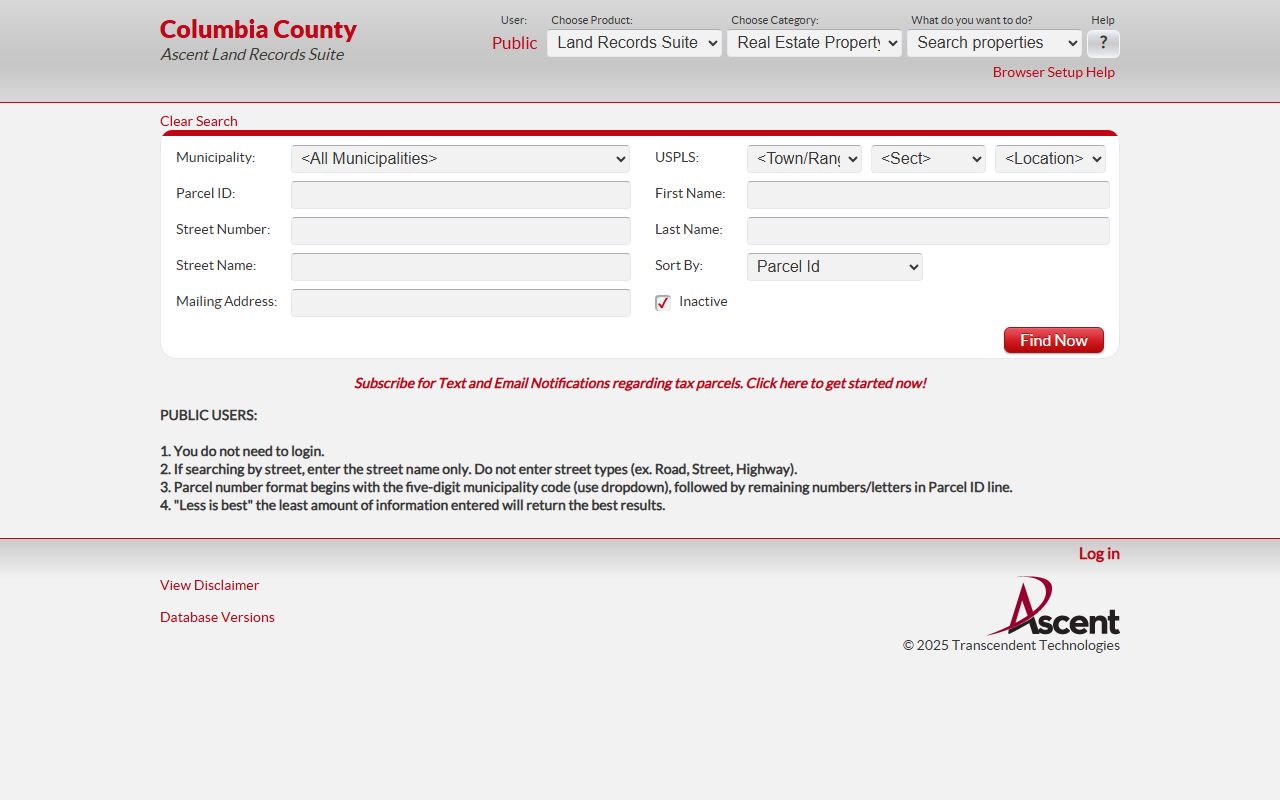
That portal is useful when you need a GIS map alongside the bill because it helps you see how the parcel is drawn, what the property characteristics look like, and how the legal description fits the tax record. The county also notes that plat books are available for purchase, which can be useful if you want a hard-copy reference for land ownership or parcel layout. In practice, that combination of map view, property data, and contact access gives Columbia County Property Tax Records users a better chance of matching the account to the correct land.
The land information department is the office to contact when a parcel needs an address correction or when you want to understand how a split or combination changed the record. For anyone comparing older tax bills with newer ones, that office detail can be as important as the tax amount itself because it explains why a parcel number, address, or property line may not look the same from one year to the next.
Wisconsin Tax Guidance and Appeals
Columbia County Property Tax Records are easier to read when you know how Wisconsin structures the rest of the tax system. The state's annual Town, Village and City Taxes Bulletin explains tax collection context across Wisconsin, while Wis. Stat. Section 73.03 describes the Department of Revenue's supervision of assessment and tax administration. If a parcel has a lottery and gaming credit, the state credit page at Lottery and Gaming Credit helps explain why the bill does not always match the raw levy line by line.
Those state sources are also helpful when a tax bill changes because of an exemption, a reclassification, or a correction after review. If a Columbia County Property Tax Records search turns up a question that cannot be answered by the bill image alone, the next step is usually to compare the county record with the assessor notice and the state rule that governs the issue. In the rare case that a Board of Review result still does not resolve the matter, Wis. Stat. Section 70.85 outlines the appeal path for qualifying cases.
For day-to-day use, the point is simpler: the county record tells you what was billed, the payment page tells you what was posted, and the assessment guidance tells you why the value looks the way it does. That is the full Columbia County Property Tax Records workflow most users need when they are trying to confirm a parcel, pay a balance, or understand a change from one year to the next.