
Dane County Property Tax Records
Dane County Property Tax Records are easiest to use when you begin with the county's own search tools and then move outward to the treasurer, real property lister, and city offices that maintain the bill and parcel history. If you are checking an owner name, street address, or parcel number, the county portals can show current tax status, payment history, receipts, assessment data, and property characteristics without sending you to a third party. That makes the record easier to trust. It also makes it faster to see what changed, when it changed, and which office handled the update.
Dane County Property Tax Records Portal
The main entry point for Dane County Property Tax Records is Access Dane. The county built that portal so users can search by owner, address, or parcel, then move directly into e-bill details, payment history, receipts, and online payment options. It does not require a login, it runs around the clock, and it is tied to GIS data so a tax search can lead into the mapped parcel without extra steps. That is useful when you want the current status, but it is even more useful when you need the full chain of record data behind the status.
The screenshot below comes from Access Dane, which is the county's primary portal for Dane County Property Tax Records research.
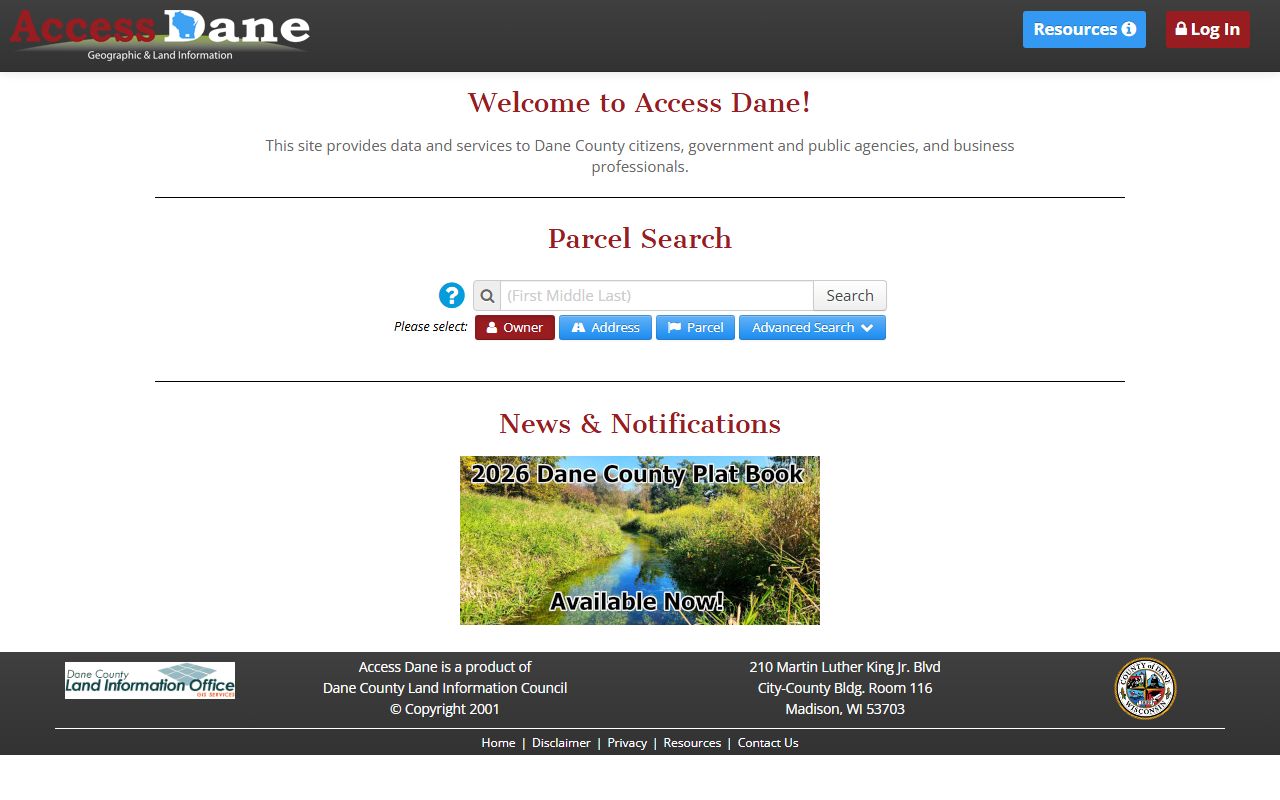
That portal is the right first stop when you need to check a bill, confirm a payment, or see whether a receipt has already been posted. It also shows assessment data, property characteristics, lottery and gaming credit information, and the payment status that helps explain why a parcel balance looks the way it does.
For deeper parcel work, the county also maintains Access Dane's deeper search interface, which adds tax distribution, special assessments, current ownership, legal description, property class, assessed value, fair market value, and first dollar or lottery credits. That combination matters because Dane County Property Tax Records often need more than a single bill image. They need the billing breakdown, the parcel history, and the explanation for the charges all in one view.
Dane County Tax Records Timing
The Dane County Treasurer is located at 210 Martin Luther King Jr. Blvd, Room 114, Madison, WI 53703, and the office phone number is (608) 266-4151. The treasurer's page points users to the current and delinquent tax portal and explains that the office handles settlements, special assessments, and delinquent collection. It also keeps historical tax rolls from 1839 through 1975, which is a significant resource when Dane County Property Tax Records need to be checked against older paper rolls or a long chain of tax changes.
That historical scope matters. A parcel that looks simple in the current portal may have a long tax trail behind it, especially if a special assessment was added, a settlement was entered, or an old roll needs to be compared with a newer digital record. The county treasurer page is where those current and past records meet, so it is the best office to use when a payment, a delinquency note, or a historical roll image is part of the question. It also helps when you need to confirm whether a bill was routed through the county or through a city office in the same tax year.
Dane County also has a Madison-specific wrinkle that matters for tax records. The City of Madison Treasurer handles the current tax season from December through July 31, while prior year taxes are handled by the county. Madison's installment dates are January 31, March 31, May 31, and July 31, and the office can be reached at (608) 266-4771 or treasurer@cityofmadison.com. If you are reading Dane County Property Tax Records for a Madison parcel, that division of responsibility is one of the first things to check.
Dane County Parcel Records Updates
The county's Real Property Lister office is where the parcel record itself gets maintained. The office handles ownership maintenance, parcel assignment and splits, assessment roll preparation, tax bill generation, Board of Review scheduling, Open Book notices, address changes, and property characteristic updates. Those are not background tasks. They are the work that keeps Dane County Property Tax Records aligned with the land on the ground and with the bill in the mail.
The screenshot below comes from the county's real property lister page at countyofdane.com/landinformation/rpl.aspx, which supports Dane County Property Tax Records updates and parcel maintenance.
That office becomes important whenever a parcel was split, combined, renumbered, or corrected after an address update. If the tax bill does not seem to match the legal description or the physical lot, the real property lister record is often the reason. It is also the place where property characteristic changes can explain a shift in value or in the way the parcel is displayed in the online tax system.
Dane County Property Tax Records and Review
When Dane County Property Tax Records show a value that does not make sense, the next step is usually the assessment review path. Wisconsin's tax and assessment rules in Wis. Stat. Chapter 70 and the Board of Review procedures in Wis. Stat. Section 70.47 explain how assessments are examined, noticed, and challenged. The Wisconsin Department of Revenue also keeps the statewide guidance in its property tax administration page and in the Wisconsin Property Assessment Manual.
That guidance is practical, not abstract. Open book is the first chance to talk with the assessor before a formal hearing. Board of Review is the official hearing step. If the board decision still does not resolve the issue, the appeal path in Wis. Stat. Section 70.85 may apply in qualifying cases. Dane County Property Tax Records make more sense once you know which step the record has already reached, because a value change can come from a correction, an appeal, or a later roll adjustment.
The county and state sources work best together. The county record tells you what was billed, the assessment file tells you why the value was set, and the state rules explain the review path. For a parcel in Dane County, that is usually enough to separate a simple billing question from a real valuation dispute.
Dane County Property Tax Records Maps and Credits
Access Dane is also helpful because it keeps Dane County Property Tax Records tied to mapped parcels and assessment context. When you search by address, the GIS layer helps you see whether the parcel line, the legal description, and the tax account all point to the same land. That matters in a county with dense city neighborhoods, changing address formats, and parcels that may have been split or updated over time. The map view gives shape to the record, while the tax data gives the billing history behind it.
The portal also shows lottery and first dollar credits, which can affect the amount due even when the underlying levy did not change much. If you are comparing one year to the next, that credit detail often explains the difference faster than the bill summary alone. It also helps when a homeowner sees a lower due amount and wants to know whether the change came from a payment, a credit, or a revised assessment.
For research that reaches back before the current portal, Dane County's treasurer materials and older roll records are useful because they preserve the history of how a parcel moved through time. That can be important for title work, for correcting a mailing issue, or for understanding why a current account looks different from an older paper record. Dane County Property Tax Records become much more useful once the map, the bill, and the history can be read together.
Wisconsin Tax Records Guidance
State resources help fill in the pieces that do not sit inside the county portal. The annual Town, Village and City Taxes Bulletin is useful when you want to compare local levy and collection context across Wisconsin. The state's owner guide in PB-060 explains the way a property tax bill is built, while PB-061 is the companion reference for agricultural use value. Those guides help Dane County Property Tax Records readers sort out what is local and what is statewide.
The lottery and gaming credit page at Lottery and Gaming Credit is another useful companion when a bill includes a credit line that changes the net amount due. The state's assessment supervision rule in Wis. Stat. Section 73.03 explains the Department of Revenue's oversight role, which is worth knowing when a local question turns into a statewide assessment issue. None of that replaces the county record, but it does make the county record easier to read.
For most users, the workflow is straightforward. Start with Access Dane, confirm the parcel and payment status, move to the treasurer if a balance or historical roll is involved, and use the real property lister when the parcel itself changed. That is the cleanest way to search, verify, and understand Dane County Property Tax Records without losing the details that make the record reliable.