
Door County Property Tax Records Search
Door County Property Tax Records are easiest to use when you begin with the county search tools and work outward from a parcel number, street address, or tax bill. The county's land records portal combines current and historical tax information with assessment data, payment history, and property characteristics, so a single lookup can answer more than one question at once. If you are trying to confirm a balance, compare an assessment to a tax bill, or understand how a parcel moved through the county record system, the online path is built for that kind of search.
Door County Property Tax Records Online
The county's main entry point is the Door County land records portal, which supports parcel and address searches, assessment data, tax bills, payment history, GIS integration, and 24/7 access. It is built for people who want current and historical Door County Property Tax Records without waiting for office hours. In practical terms, the portal lets you move from a search result to the parcel detail, then to the bill image or payment status, without having to repeat the same lookup in several different systems.
The same portal is also where the county surfaces property characteristics, tax certificate information, and delinquent tax status. That matters because a tax search is often not just about the amount due. It is also about whether a parcel has a past-due balance, whether a certificate has already been issued, and whether the record reflects the correct mailing and site information. For that reason, the county land records page is usually the best first stop when you need a clear picture of Door County Property Tax Records.
The county treasurer office is the other half of that picture. Door County Treasurer handles property tax collection, delinquent management, tax certificate issuance, online payment options, address changes, and settlements. If the portal shows a balance you need to resolve, the treasurer page is where the county explains how that balance is managed after the search result has already identified the parcel.
Door County Property Tax Records Search Tools
The land records portal is useful because it connects tax information to the county's broader parcel environment. You can search by parcel number or address, then use the result to review current and historical records, map context, and property characteristics in one place. That is especially helpful when a street address has changed, a mailing address is out of date, or a property has been split, merged, or described differently in older records. Door County Property Tax Records become much easier to read once the parcel reference is stable.
Because the portal includes payment history, it can help you see whether a balance was posted, paid, or moved into delinquency. That is important for title work, closing checks, and ordinary homeowner questions alike. A tax bill can look simple on paper, but the search tools let you see whether the amount reflects a credit, a previous payment, a special assessment, or a prior year adjustment that is not obvious from the face of the bill.
The screenshot below comes from Wisconsin's property tax statutes page at Wis. Stat. Chapter 70.
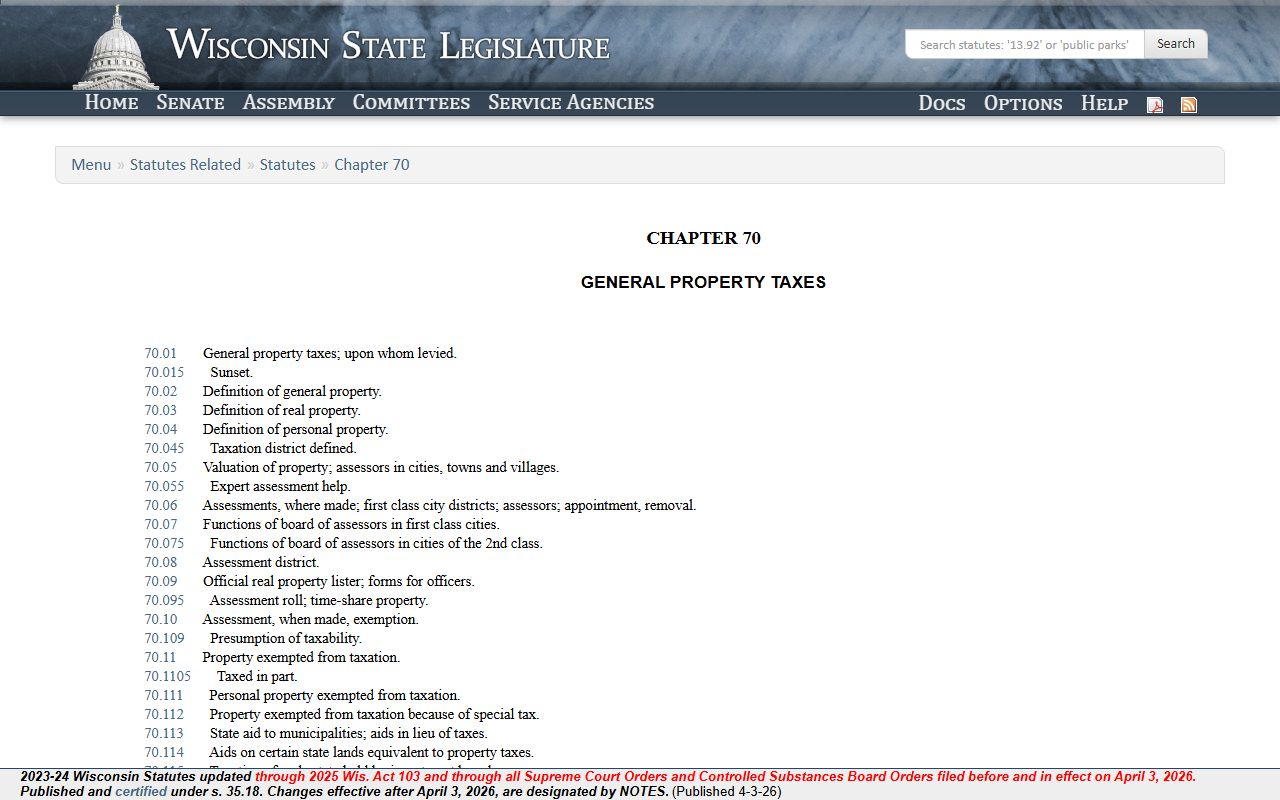
It is a useful statewide reference when you want to understand how Door County Property Tax Records fit within Wisconsin's general assessment and tax-roll framework. If the county portal leaves you with a value question or a billing question, the state rules help you interpret what the county record is showing.
Door County Treasurer and Property Tax Records Payments
The Door County Treasurer is located at 421 Nebraska Street in Sturgeon Bay, WI 54235, and the office can be reached at (920) 746-2240. That office handles property tax collection, delinquent tax management, tax certificate issuance, online payment options, address changes, and tax settlements, so it is the place to contact once a search result has already confirmed which parcel and installment you are dealing with. If you need to sort out a payment that has not posted the way you expected, the treasurer is the office that can reconcile the county record with the actual payment path.
The treasurer page is also important because it ties online payment questions to the county's longer tax cycle. Some balances can be paid online, while older delinquent amounts may move into a different handling process. If you are relying on Door County Property Tax Records to keep the schedule straight, you want to confirm whether the installment is current, whether the balance has already been certified, and whether an address change or settlement needs to be reflected before you send another payment.
For people reviewing a parcel after the due date, the most useful details are often the simplest ones: whether the payment was applied, whether the balance is still outstanding, and whether the county has already issued a certificate. The treasurer office is the source for that information, while the land records portal is the place where you verify the parcel and bill details before you take the next step.
Door County Property Tax Records, Assessments, and Open Book
When Door County Property Tax Records show a value that does not make sense, the next step is usually the assessment review process. The county assessor page at Door County Assessor explains Open Book schedules, Board of Review procedures, objection forms, municipal assessor contacts, assessment roll information, valuation data, equalized values, and revaluation notices. That makes it the right place to start if you need to understand why a parcel's assessed value changed or why a tax bill changed from one year to the next.
State guidance matters here because the county process sits inside Wisconsin law. Wis. Stat. Chapter 70 provides the general tax and assessment framework, while Wis. Stat. Section 70.47 covers Board of Review procedure. The Department of Revenue also provides broader guidance through the property tax administration portal, the Wisconsin Property Assessment Manual, and PB-055. If a parcel moves from open book to a formal hearing, those state references help explain the timing and evidence rules that shape the record.
Door County Property Tax Records often become more useful after an assessment review because the assessment file and the tax bill start to tell the same story. A revised value, a corrected characteristic, or a revaluation notice can explain why the current bill is different from the prior year. If you are trying to understand the reason for a change, the assessor page and the county land records system should be read together instead of separately.
Door County Property Tax Records and Deeds
When a Door County Property Tax Records search leads to a deed, mortgage, lien, plat, or survey reference, the Register of Deeds is the office that finishes the chain. The county register of deeds page at Door County Register of Deeds is located at 421 Nebraska Street in Sturgeon Bay and can be reached at (920) 746-2210. The office offers LandShark access, deed, mortgage, and lien records, copy services, historical records, document images, UCC filings, plats, surveys, and vital records.
That matters because tax records and recorded documents support each other. A parcel may show a reference to a deed or a legal description in the land records system, but the actual instrument lives in the recording office. If you are tracing a sale, confirming a legal description, or checking whether a recorded change matches the tax roll, the Register of Deeds can provide the source document behind the county record. For that reason, Door County Property Tax Records are best understood as part of a larger property file rather than as a standalone bill image.
The same approach helps when you are reviewing older parcels. Historical record images, plats, and surveys can clarify why a property changed shape or why a later bill uses a different legal description. If the tax portal shows a result that does not line up with the map, the recording office is usually the place that explains the difference.