
Search Juneau County Property Tax Records
Juneau County Property Tax Records are easiest to work with when you begin at the county level and follow the parcel through tax, land, and assessment sources. A search by address, parcel number, or owner name can lead you to the current bill, ownership history, recorded documents, and assessment notes without jumping between unrelated sites. That makes it simpler to confirm a payment, check a change in value, or trace a property back to the records that explain why the account looks the way it does. If you need a clean path to the record, Juneau County has one.
Juneau County Property Tax Records Portal
The main online entry point for Juneau County Property Tax Records is the county Land Records Web Portal. It supports searches by type, name, public land survey, parcel number, or address, which is useful when you know only part of the record and need the county to fill in the rest. The portal also connects tax and assessment information, ownership records, GIS mapping, document recording access, current and historical records, mobile access, property characteristics, and tax certificate information. That combination turns a basic lookup into a full parcel check.
The portal matters because it keeps the working pieces together. A bill may show one mailing name, a deed may show another, and a parcel map may show a third label if the property has changed over time. The county search helps tie those details back to one account. It also gives you a quick way to compare the current record with older records when the question is about a split parcel, a changed address, or a tax line that does not match the expectation. That is the kind of search that saves time before you call an office.
The reference image below comes from Wisconsin Statutes Chapter 70 at docs.legis.wisconsin.gov/statutes/statutes/70.
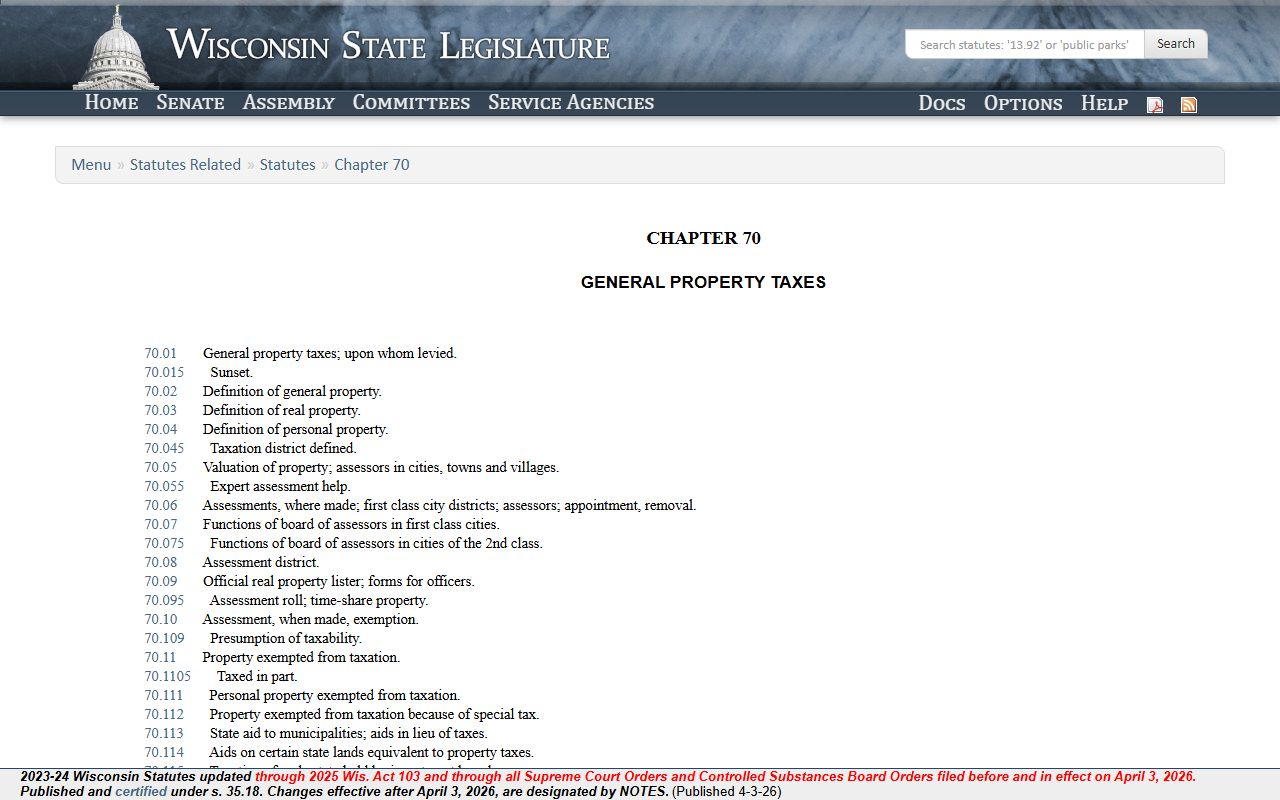
That statewide reference is useful because Juneau County Property Tax Records sit inside Wisconsin's broader property tax framework, so the parcel record, the bill, and the law all need to line up.
Juneau County Treasurer Records
The Juneau County Treasurer is the office that turns a tax bill into a payment record. The office is at 220 E. State Street, Mauston, WI 53948, and the phone number is (608) 847-9308. The treasurer handles property tax collection, delinquent management, tax deed sales, online payment options, tax bill information, investment, settlement administration, and coordination with municipal treasurers. If you are checking Juneau County Property Tax Records for a balance, that is the office that confirms what the county says is due.
The treasurer page is especially useful when a payment needs to be traced. If a parcel was paid online, paid by mail, or settled through another local office, the treasurer record should show the result. When the account does not match the receipt, the cause is usually a posting delay, a parcel label difference, or a payment that was applied to a prior installment cycle. The county's system is built to show the tax bill side of the record, so it is the right place to start before you assume the record is wrong.
For Juneau County Property Tax Records, the treasurer is also the office to watch when delinquency starts. The same page that shows the current bill can also point you toward collection status, settlement questions, and the tax deed path if the parcel moves beyond ordinary payment timing. That makes the treasurer page more than a balance lookup. It is part of the county's record trail.
Juneau County Property Tax Records and Deeds
When Juneau County Property Tax Records point you toward a deed, the Register of Deeds is the next stop. The office is at 220 E. State Street, Room 212, Mauston, WI 53948, and the phone number is (608) 847-9325. The office provides grantee and grantor indexes, online document search, certified survey maps and plats, copy and certification services, historical records, UCC filings, and vital records. That mix of tools is important when a tax question is really a document question in disguise.
A parcel can change hands, split, merge, or update its legal description over time. When that happens, the deed record can explain why the tax record no longer looks like the older paper file you have in mind. The county's online document search helps you move from a parcel result to the recorded source material without guessing which office handled the change. If you are checking ownership, a survey, or a plat, the Register of Deeds page is the cleanest way to verify what was recorded and when it was recorded.
Juneau County Property Tax Records and Assessment
The county Assessment office is where the valuation side of Juneau County Property Tax Records becomes easier to read. The office maintains property assessment records, the assessment roll, Board of Review information, Open Book notices, objection forms, assessor contacts, valuation data, equalized values, notices, and revaluation information. That is the background you need when the bill looks odd but the payment history is not the issue. It is also the place to check if you want to understand how the county got to the value shown on the tax record.
Assessment records and tax records work together. A tax bill shows the amount due, but the assessment file explains the value behind the bill and the review path when the value needs to be questioned. Open Book is the informal discussion step, and the Board of Review is the formal hearing stage. If a parcel was revalued, or if an objection form was filed, the assessment page is where those public notices and record steps should appear. For anyone reading Juneau County Property Tax Records closely, that review trail matters as much as the final amount on the bill.
If the value seems off, compare the county's assessment notices with the parcel details in the land records portal before you assume the tax bill is the only source of truth. Small data mismatches often show up first in the assessment file.
Delinquent Juneau County Property Tax Records
Delinquent Juneau County Property Tax Records are not just a late-payment issue. They can also be a sign that the parcel is moving into the county's collection process, a settlement file, or a tax deed track. The treasurer page explicitly includes delinquent management, tax deed sales, settlement administration, and municipal treasurer coordination. That means the county is handling the record as a financial file and as a public record at the same time. If you are trying to catch up after a missed due date, start there.
The land records portal adds another layer because it includes tax certificate information. That is helpful when the question is not just whether a bill was paid, but where the parcel stands in the county's collection record. You may need the payment history, a recorded deed image, or the tax certificate reference to get the full picture. In practice, the county treasurer and land records portal should be used together whenever the account has moved past ordinary billing and into delinquency or sale-related questions.
Wisconsin Property Tax Guidance
When Juneau County Property Tax Records need a legal or procedural frame, Wisconsin's state resources fill in the missing pieces. Wis. Stat. Chapter 70 covers the general property tax system, Section 70.47 explains Board of Review procedure, and Section 70.85 describes a state review path for eligible properties. The Department of Revenue's property tax administration page and the Wisconsin Property Assessment Manual are useful when you want the local record to line up with statewide practice.
For a property owner, the state publications can save time. PB-055 explains the appeal process, PB-060 helps readers understand the bill, and the Lottery and Gaming Credit page explains why a homestead account may show a lower net amount than the levy line suggests. Those references do not replace county records, but they make the county record easier to read and easier to challenge when needed.
If you need another lookup, use the search widget below and start again with the parcel number, address, or owner name. Juneau County's public record trail works best when the land records portal, treasurer page, deed record, and assessment office are read together, since each one explains a different part of the same property file.