
Lincoln County Property Tax Records
Lincoln County Property Tax Records are easiest to handle when you start with the county's treasurer and land services pages, then work toward the deed record if you need more context. The county gives you a public path for parcel and tax searches, plus the background pieces that show ownership, assessment data, and map detail. That makes it possible to move from a street address to the bill, then from the bill to the parcel record, without relying on a patchwork of outside sites. For routine checks, historical lookups, or a quick review before a payment, the county's official tools keep the work focused and local.
Lincoln County Property Tax Records Portal
The county's real estate and tax data search page at co.lincoln.wi.us/land-services/page/real-estate-and-tax-data-search is the clearest public entry point for Lincoln County Property Tax Records. The page says users can search land ownership, assessment data, property tax information, current and historical records, GIS details, and tax certificate information. It also notes mobile access and 24/7 availability, which matters when you need a parcel answer outside normal office hours. When the record is current, the search can confirm the bill. When it is historical, the same tool helps show how the record changed over time.
That search function is useful because a tax record is rarely just a single number. A parcel can carry a changed address, an updated owner line, or a tax note that makes sense only when you compare it to the map and assessment record. The county's online search makes that comparison practical. You can start with a parcel number, then use the matching tax and assessment data to see whether the record lines up with what you expected. If it does not, the county portal gives you the clues that help narrow the issue before you call an office.
The county's real estate and tax data search page at co.lincoln.wi.us/land-services/page/real-estate-and-tax-data-search is another direct entry point for Lincoln County Property Tax Records.
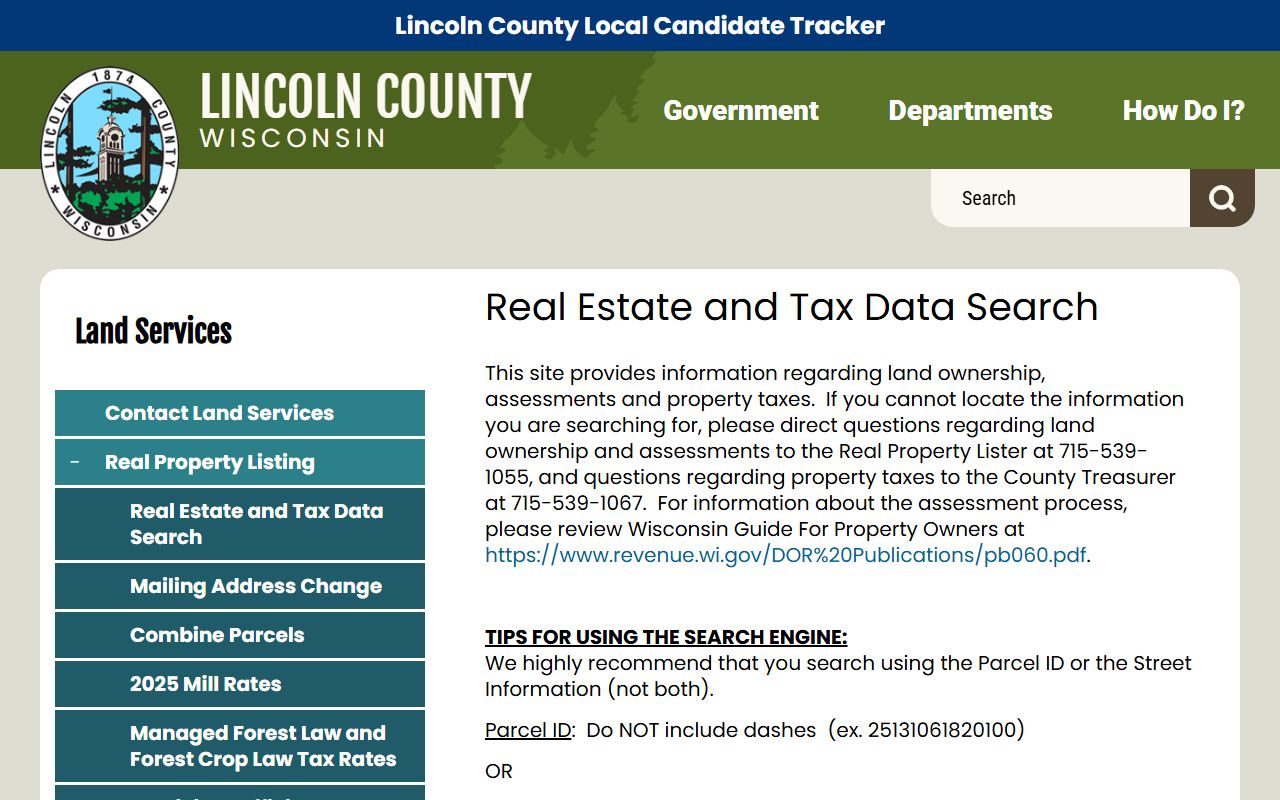
It is useful because it pulls land ownership, assessment data, tax information, GIS detail, and tax certificate information into one public search flow.
The screenshot below comes from the Lincoln County Treasurer page at co.lincoln.wi.us/treasurer.
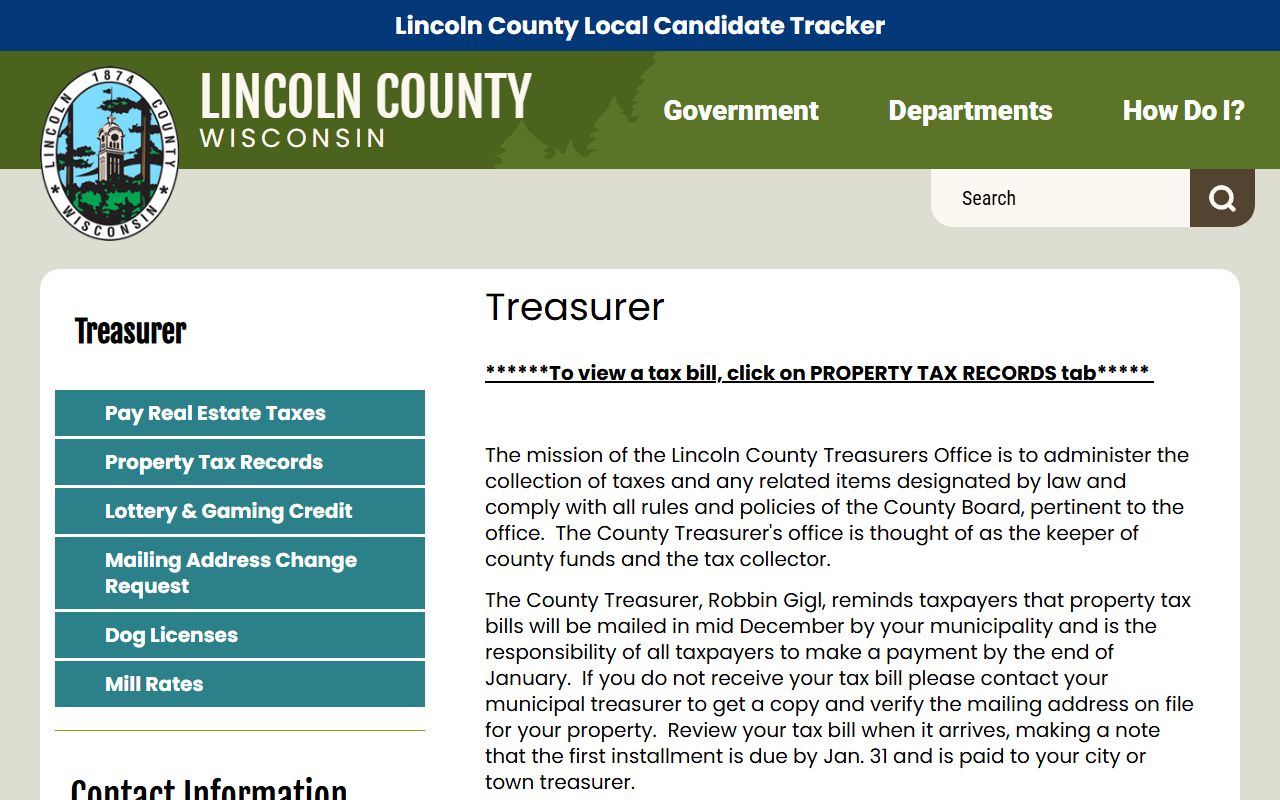
That image points back to the office that handles tax bill viewing, tax collection, records maintenance, settlement administration, delinquent collection, and municipal coordination.
Lincoln County Treasurer Property Tax Records
The Lincoln County Treasurer page at co.lincoln.wi.us/treasurer lists Robbin Gigl, County Treasurer, and the office is at 801 N. Sales Street, Suite 204, Merrill, WI 54452. The phone number is (715) 539-1067, and the fax number is (715) 539-8095. The treasurer page says the property tax records tab is used for tax bill viewing, tax collection and records maintenance, settlement administration, delinquent collection, and municipal coordination. For Lincoln County Property Tax Records, that makes the treasurer the office that turns a bill search into a payment history check or a collection question.
The county treasurer page is practical because it keeps the working parts in one place. If you are verifying a bill, the page helps you confirm whether the county has the record you need. If a payment was made, it helps you think through whether the payment has posted or whether it still sits in a settlement workflow. If the account is older, the same page gives you the collection path that matters most. The office is not just a payment desk. It is part of the record trail that ties current billing to the county's tax file.
The treasurer page at co.lincoln.wi.us/treasurer is also the best county-side place to start when a parcel has moved into delinquent status. In that setting, the bill is no longer the only thing that matters. Settlement timing, collection steps, and coordination with municipalities can all affect what the record shows and how the balance should be read.
Lincoln County Property Tax Records and Land Services
The broader land services page at co.lincoln.wi.us/land-services/ connects Lincoln County Property Tax Records to property search, assessment information, parcel mapping, GIS, land records, ownership, zoning, aerial photography, printable maps, and mobile access. That matters because a tax record often depends on the parcel map. If the map changed, the tax record may need to be read with that change in mind. If the owner line changed, the tax record may need to be compared against the land record and the assessment file. The county's setup lets you move between those pieces without leaving the official site.
That page also shows how Lincoln County organizes the record around land use, not just billing. A parcel search can reveal where the property sits, how it is classified, and what supporting layers sit behind the tax entry. That is useful if you are checking a sale, a split, or a parcel with an old description that no longer fits neatly on paper. The GIS and printable map tools give the record a visual side, while the ownership and assessment pages help explain why the bill looks the way it does.
The screenshot below comes from the Lincoln County land services page at co.lincoln.wi.us/land-services/.
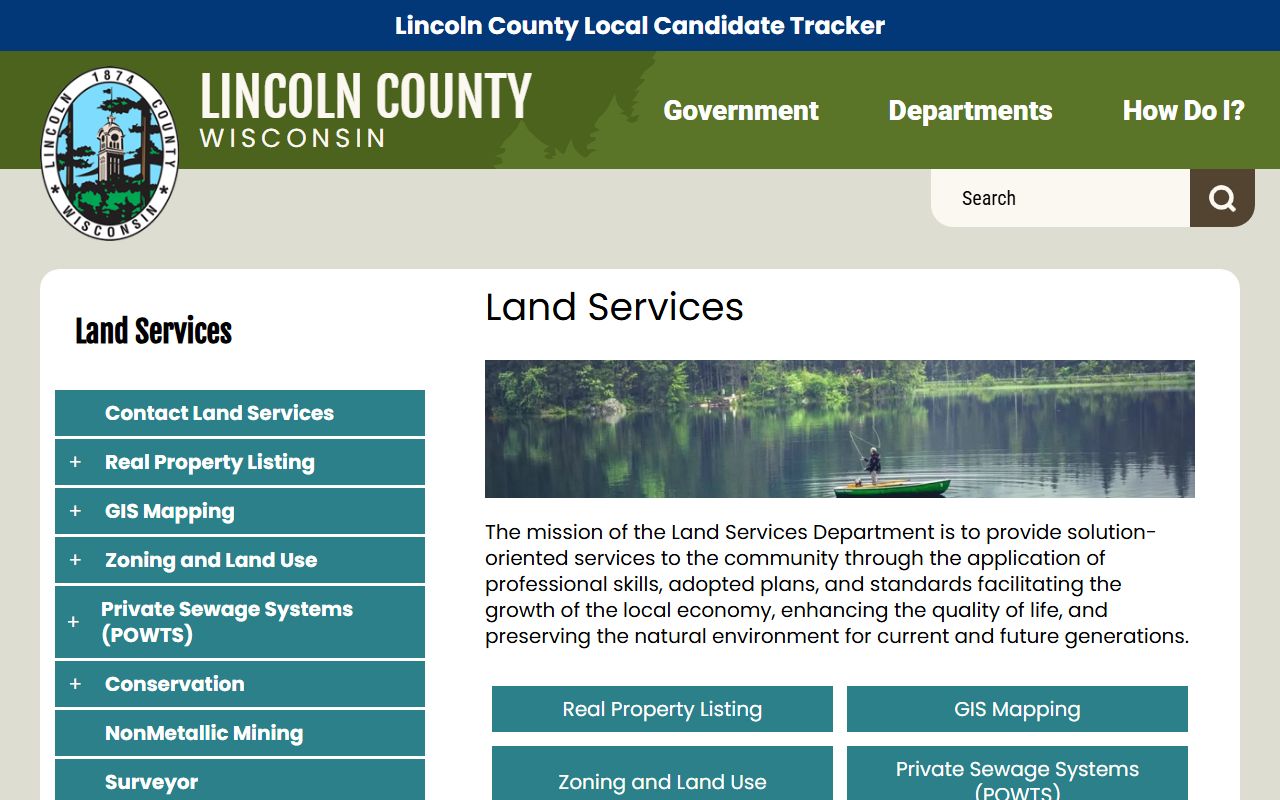
That view is useful when you want the parcel, map, and tax record to stay in the same working frame.
Register of Deeds and Lincoln County Records
Lincoln County Property Tax Records often lead to a deed or other recorded document, and that is where the Register of Deeds becomes important. The office can be reached at co.lincoln.wi.us/register-of-deeds, and the phone number is (715) 539-1070. The county describes the office as a place for land records search, online document access, recording, certified copies, historical records, UCC filings, plats, and vital records. If the tax line raises a title question, the deed record is usually the next step.
The deed side of the record is useful because tax research and recording research often overlap. A parcel may change owners, receive a new legal description, or carry a recorded reference that explains the assessment entry. If you are comparing a tax bill to a sale, lien, or plat, the Register of Deeds page helps you find the source document instead of guessing from the tax screen alone. That is especially helpful when the county search gives you a parcel, but you still need the recorded paper trail behind it.
For Lincoln County Property Tax Records, the office works as the document backstop. The treasurer shows the bill status. Land services shows the parcel context. The Register of Deeds shows what was actually recorded. Put together, the three pages give you a more reliable read of the property history.
Lincoln County Property Tax Records and Wisconsin Guidance
When Lincoln County Property Tax Records raise a value or classification question, Wisconsin's own guidance is the best way to check the county record against the statewide rules. The Department of Revenue's property tax administration resources at revenue.wi.gov/Pages/Governments/home.aspx explain how local assessment and tax work fits into the state system. The Wisconsin Property Assessment Manual is also useful when you want to understand the terms that appear in the county record.
If a parcel value looks off, those state references help you move from the raw tax entry to the reason behind it. A tax bill can reflect land class, improvements, or district changes, and the manual gives you the terms needed to read that language with less guesswork. The county record still controls the local answer, but the state guidance helps you interpret what the record means and why a figure may have changed from one year to the next.
For deeper review, Wisconsin law in Wis. Stat. Chapter 70 and the Board of Review procedure in Wis. Stat. Section 70.47 give the structure behind local assessment disputes. That does not replace the county record. It helps explain the path that led to it.
Delinquent Lincoln County Property Tax Records
Delinquent Lincoln County Property Tax Records matter because the county treasurer page specifically references delinquent collection and settlement administration. Once a balance gets older, the record is no longer just about whether a bill exists. It is about how the county tracks the account, how it coordinates with municipalities, and whether the parcel is moving through a collection step that should be read with extra care. The same public tools that help with a current search also help you see where an older account sits in the process.
That is why it helps to keep the parcel number, tax year, and address together when you are searching. A delinquent record can be harder to read if the property changed hands or if the address in the file is older than the one used by the current owner. Lincoln County's land and treasurer pages give you a way to work through that problem by linking the tax record to ownership and mapping data. If a tax certificate note appears, the county search can show where the parcel stands without sending you to a separate commercial system.
For Lincoln County Property Tax Records, the cleanest workflow is still simple. Check the parcel in land services, confirm the bill with the treasurer, and go to the Register of Deeds when the question becomes a recorded document question.
If you need another lookup, use the search widget below and start again with the address or parcel number. Lincoln County's public record trail works best when the search, treasurer, land services, and deed pages are read together, so the widget is a practical reset point whenever you need to confirm a bill or follow the property record farther.